

Electric scooters use lithium-ion (Li-ion) batteries because they store far more energy per pound than lead-acid or nickel-based batteries, last through more charge cycles, and hold their charge better in storage. That combination is what makes a modern scooter light enough to carry, with enough range for a real commute.
Below, we look at how scooters got here, from early gas and lead-acid models to the 21700 lithium-ion cells in today's Apollo lineup, and at the battery technologies that could come next.
A Short History of Powered Scooters
Powered scooters are older than most people think. The Autoped, introduced in 1915, was one of the first mass-produced motorized scooters. It ran on a small gasoline engine mounted over the front wheel, and riders stood on a platform much like they do today. A battery-electric version was also built, but gas was the practical choice at the time.

Lady Florence Norman on her Autoped in London, 1916. Public domain, via Wikimedia Commons.
For more on its story, check out The 1915 Autoped Motorized Scooter: The World's First Powered Production Scooter.
Gas-Powered Scooters: Still Around, With Trade-Offs
Gas scooters never fully disappeared. The GoPed is the best-known example, and it's still sold today. Original Go Ped Sport SE.


As with cars, gas has real upsides. Gasoline holds far more energy than lead-acid, sealed lead-acid (SLA), or even lithium-ion batteries. Refilling a tank takes under a minute, while even a fast charger needs a few hours to recharge an electric scooter.
For Energy Density, Gasoline Is Still King
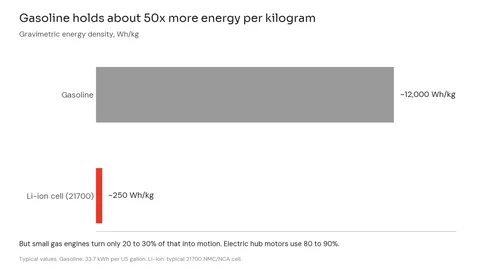
Gasoline packs roughly 12,000 Wh per kilogram, around 50 times more than a lithium-ion cell. But gasoline isn't rechargeable. It's burned and replaced.
That energy also isn't used very well. Small gas engines turn only about 20 to 30% of their fuel's energy into motion. The brushless DC motors in scooters and e-bikes typically run at 80 to 90% efficiency. Even with that gap, a gas scooter can still out-range a battery-powered one.
Why Not Use Gasoline?
If gas has so much energy, why aren't we all riding GoPeds? A few reasons:
- Maintenance. Most gas scooters use two-stroke engines that need premixed gas and oil (some four-stroke models now exist). They need regular tuning, and they're noisy.
- Power delivery. Gas engines only make useful power in a narrow RPM band, so they need a clutch to disconnect from the wheel when stopped. Electric motors make full torque from a standstill with no clutch, which means smoother starts and more predictable throttle response. Dual-motor setups, common on performance electric scooters, would be impractical with gas.
- Regulation. Many jurisdictions now restrict small two-stroke and four-stroke engines. California, for example, began phasing out sales of new small off-road engines in 2024.
- Handling fuel. A battery stays sealed inside the scooter. With gas, you handle the fuel directly, including mixing it for two-stroke engines. Gasoline vapor and skin contact are toxic, and the liquid is highly flammable.
Battery-Powered Scooters Go Mainstream
Electric scooters made a comeback roughly 25 years ago, this time running on lead-acid batteries.
The eZip E-500 is a good example of a later maintenance-free SLA scooter, built on a Currie Technologies motor and controller. Currie helped popularize this style of scooter starting around 1999 with 24-volt and 36-volt systems. Models like these typically topped out around 15 mph with about 8 miles of range.
SLA batteries weren't a great fit for scooters. They don't handle deep discharges well, which is exactly how a scooter uses its battery, and they store very little energy for their weight and size.
Since then, better controllers (sine wave) and motors (brushless, high-torque direct drive) have made personal electric vehicles (PEVs) practical and affordable. But the real game changer was the battery. Quality Li-ion packs made scooters practical for recreation, commuting, and last-mile trips.
Why Li-Ion?
It comes down to three things: energy density, cycle life, and self-discharge. Compared with gasoline, safety and environmental impact matter too. Energy density matters most, because it decides how much power and range fit into a battery that's light and small enough for a scooter.
Energy Density: More Range in Less Weight
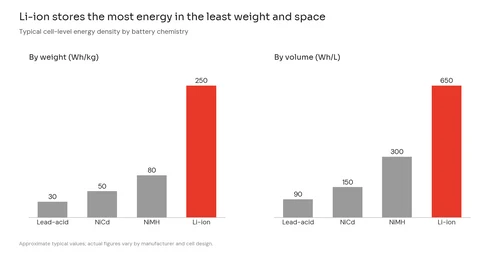
Energy density is Li-ion's biggest advantage. Of the common rechargeable chemistries, Li-ion is both the lightest and the most compact for the energy it stores. Compared with the lead-acid batteries scooters used to run on, Li-ion cells hold about 8 times the energy per kilogram and take up about a seventh of the space. They also clearly beat nickel-metal hydride (NiMH), which was once common in hybrid cars and power tools.
Here's what that looks like on two scooters of nearly the same weight, built about 25 years apart:
|
|
Currie Phat Flyer (c. 2000) |
Apollo City (2024) |
|---|---|---|
|
Weight |
63 lb |
65 lb |
|
Battery |
SLA, 24V |
Li-ion, 48V |
|
Energy |
240 Wh |
960 Wh |
|
Range |
Up to 10 miles |
Up to 43 miles |
|
Top speed |
15 mph |
32 mph |
Four times the energy for two extra pounds. That's the Li-ion difference. The Apollo City's pack is built from 52 individual 21700 cells, each about the size of a thick marker.
Cycle Life: How Many Charges a Battery Lasts
Cycle life is how many times a battery can be fully discharged and recharged before its capacity drops noticeably. It decides how long a scooter stays practical. And because the battery is one of the most expensive parts of a scooter, it matters for long-term cost too.
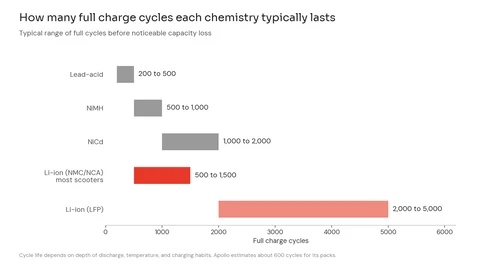
Li-ion comfortably outlasts lead-acid and NiMH. NiCd is durable too, but it's heavy and contains toxic cadmium, and lithium iron phosphate (LFP) cells outlast them all. A quality Li-ion scooter pack typically keeps most of its capacity for several hundred full cycles, and Apollo's support center estimates about 600 charge cycles for its batteries. Since most rides use only part of a charge, that often works out to years of riding. For a deeper look, see How Long Do Electric Scooter Batteries Last?
What about lithium polymer (LiPo)? LiPo cells are a type of lithium-ion battery that uses a flexible pouch instead of a metal can. They're common in drones and phones. For scooters, cylindrical cells like the 21700 usually win on cost per watt-hour, durability, and ease of building into a large pack.
Self-Discharge: Holding a Charge in Storage
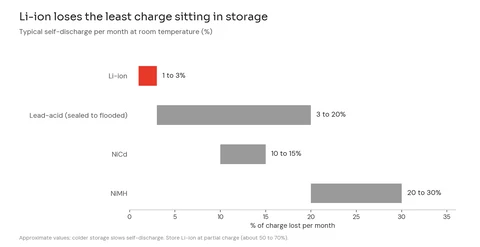
Every battery slowly loses charge even when nothing is using it, like a scooter sitting switched off in the garage. Li-ion loses only about 1 to 3% a month at room temperature, the lowest of the common chemistries. Lead-acid and NiMH lose charge much faster.
That low self-discharge, plus energy density and cycle life, is why the switch from lead-acid to Li-ion made modern e-bikes, scooters, and even electric cars viable everyday transportation. For storage tips, see Apollo's charging best practices.
Inside a 21700 Cell
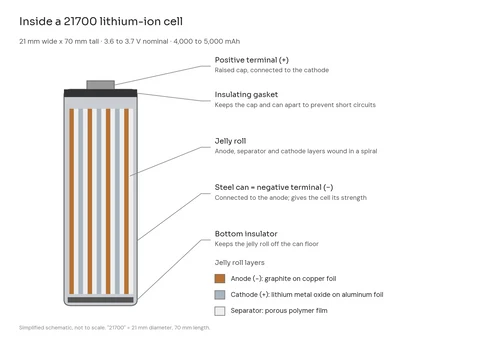
The "21700" name is simply the cell's size: 21 mm wide and 70 mm tall. Each cell holds a tightly wound "jelly roll" of electrode layers and a separator. A typical 21700 runs at 3.6 to 3.7 volts and stores 4,000 to 5,000 mAh, or roughly 15 to 18 Wh. Wire dozens of them together and you get a scooter battery pack. You can find pack specs for every model on Apollo's battery and charging support page.
As Great as It Is, Li-Ion Isn't the Last Word
Li-ion batteries are a huge step up from the chemistries that came before. E-bikes, scooters, electric cars, and trucks are only practical because of them.
Batteries are central to our energy future, and while Li-ion keeps improving, researchers are testing what comes next. There's a lot of money at stake, and this field is moving fast.
What Are the Downsides of Lithium-Ion Batteries?
- Supply constraints. Lithium isn't scarce in the ground, but mining and refining capacity has struggled to keep up with demand.
- Sourcing concerns. Lithium, cobalt, and nickel mining raise real environmental and geopolitical issues.
- Recycling. Recycling technology can recover most of the metals in a battery, but collection rates are still low and the process is costly.
- Cycle life. Li-ion lasts far longer than lead-acid, but repeated deep discharges still wear it down.
- Fire risk. Damaged or poorly managed cells can go into thermal runaway, and fire can spread from cell to cell. A good battery management system (BMS) and certified packs reduce that risk. Learn more in E-Scooter Battery Fire Risks and How to Stay Safe.
- Aging. Batteries slowly lose capacity over time, even with perfect care.
- Cold weather. Li-ion delivers less range near and below freezing, and it shouldn't be charged below 32°F (0°C).
What Comes After Lithium-Ion?
Next-generation batteries aim for higher energy density, faster charging, better safety, and more sustainable materials. As they mature, expect them in scooters, cars, trucks, and consumer electronics first. Bigger leaps could open up uses like medical implants, aircraft, grid storage for solar and wind, locomotives, and ships.
These technologies are still early, and delays between the lab and real products are common. It's not just the cells, either. Battery management systems, controllers, and chargers have to be built to match.
Here are five being actively researched:
- Solid-state batteries. These replace the liquid electrolyte with a solid, such as a ceramic or polymer. That promises higher energy density, faster charging, and lower fire risk. Toyota plans to launch EVs with all-solid-state batteries in 2027 to 2028, and Nissan is targeting the end of fiscal 2028.
- Lithium-sulfur batteries. These use sulfur in the cathode, offering higher energy density and less reliance on cobalt and nickel. They're promising for EVs, aircraft, and energy storage. They still rely on lithium, though, and short lifespan and corrosion remain hurdles.
- Sodium-ion batteries. Sodium is cheap and abundant, and these batteries handle cold well. CATL's Naxtra sodium-ion cells reach about 175 Wh/kg, close to lithium iron phosphate (LFP), and CATL says mass-produced products are launching in 2026. BYD is investing heavily too. They're still heavier than the Li-ion cells in today's scooters.
- Lithium-metal batteries. Using lithium metal as the anode could roughly double energy density. The challenge is dendrites: tiny, branch-like lithium crystals that grow during charging and can cause short circuits or fires. Solid-state and new electrolytes may help solve this.
- Graphene-enhanced batteries. Graphene improves conductivity and heat management, which could mean faster charging and longer life. Production cost and scale are the main hurdles so far.
For Now, Li-Ion Is King
Until one of these technologies is ready for everyday riders, lithium-ion remains the best balance of range, weight, lifespan, and cost for electric scooters. To see how that plays out on the road, explore the Apollo lineup.
In Part II, we'll cover living with Li-ion: how to charge, store, and care for your scooter's battery so it lasts.
Frequently Asked Questions
Why do electric scooters use lithium-ion batteries instead of lead-acid? Li-ion stores about 8 times more energy per kilogram than lead-acid, lasts through more charge cycles, and loses less charge in storage. That means more range from a lighter, smaller battery.
What is a 21700 battery cell? A 21700 is a cylindrical lithium-ion cell that measures 21 mm across and 70 mm tall. It typically stores 4,000 to 5,000 mAh. Scooter packs, like the one in the Apollo City, are built from dozens of these cells wired together.
How many charge cycles does an electric scooter battery last? A quality Li-ion scooter battery typically lasts several hundred full charge cycles before losing noticeable capacity. Apollo estimates about 600 cycles, depending on charging and storage habits.
Are gas scooters better than electric scooters? Gas scooters refuel faster and can go farther, but they need more maintenance, are noisier, and face growing regulation. Electric scooters deliver instant torque, smoother starts, and zero tailpipe emissions.
Will solid-state batteries replace lithium-ion in scooters? Possibly, but not right away. Automakers like Toyota are targeting 2027 to 2028 for their first solid-state EVs. Scooters will likely follow once costs come down and compatible chargers and controllers exist.