
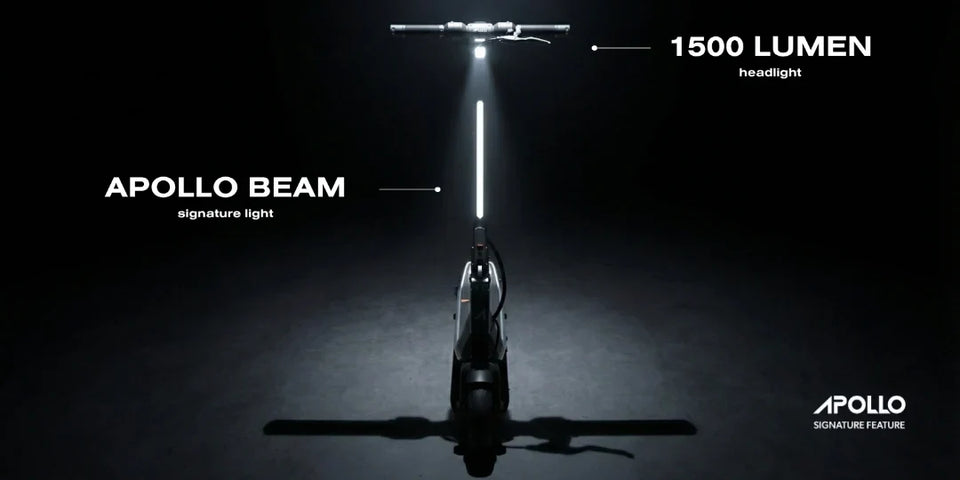
There is no single lumen number that covers every rider. The practical target is a front light strong enough to illuminate your path at speed, paired with rear and side visibility bright enough that others notice you well before they are close. This guide walks through what brightness measurements actually mean, what changes how bright your lights need to be, and how Apollo Beam, Apollo's lighting system, approaches the problem.
How bright is bright enough
There is no single legal brightness number that applies to every electric scooter or every rider. The practical goal is a front light strong enough to illuminate the road at your riding speed, so you have time to react to what is ahead of you, combined with rear and side lighting bright enough that drivers and pedestrians notice you before they are close. Brightness needs rise as speed increases, since more forward light means more reaction time, and as ambient light drops: dusk, night, rain, and fog all cut visibility.
CHECK YOUR LOCAL RULES
E-scooter lighting requirements in Australia are set state by state, alongside the broader rules on where private e-scooters can legally be ridden, which vary significantly between states. Check your state's e-scooter and lighting rules for anything mandatory, particularly around rear lights and reflectors.
Understanding lumens and how scooter brightness is measured
Lumens measure a light's total output, and it is the figure most manufacturers list, so it is the number you will see most often on a spec sheet. But lumens alone do not tell you how well a scooter light performs on the road. Being seen (visibility to others) and seeing (lighting the road ahead) are two different jobs, and a light tuned for one does not automatically do the other well.
Beam pattern and aim affect how usable that light actually is, as much as raw lumen count does. A well-aimed light that throws its beam forward and down the road can outperform a brighter, unaimed light that scatters upward or stays too close to the front wheel.
Lumens versus lux: a quick distinction
Lumens measure total light output from the source. Lux measures how much of that light actually lands on a surface at a given distance, which is closer to what a rider experiences as usable brightness on the road ahead. Two lights with identical lumens can illuminate the road very differently depending on how tightly the beam is focused.
Factors that decide how bright your lights should be
-
Riding speed: faster riding needs more forward-throw light to give you time to react to hazards.
-
Riding environment: unlit streets, trails, and paths need more output than well-lit roads with streetlights.
-
Time of day and weather: dusk, night, rain, and fog all reduce how far your lights, and you, can be seen.
-
Traffic context: riding alongside cars raises the importance of being visible from every angle, not just from the front.
Why being seen matters as much as seeing
A bright front light helps you see the road, but does little to keep you visible to a driver approaching from behind or the side, exactly where scooter riders are hardest to spot. Rear lights, brake indication where available, and side or deck lighting round out the picture, giving others more warning before they are close.
LIGHTING SUPPORTS, IT DOESN'T REPLACE, GOOD JUDGMENT
Good lighting supports visibility and rider control, but it does not eliminate risk. Pair it with a helmet, reflective clothing where it makes sense, and always follow your state's e-scooter and lighting rules.
Discover Apollo Beam: Apollo's approach to scooter lighting
Apollo Beam is the lighting system built into Apollo's current scooter lineup, designed around the same seeing-and-being-seen problem covered above. It centers on a high-output, forward-facing headlight mounted in the stem rather than down near the front wheel, giving it a longer, more usable throw down the road.
WHAT APOLLO BEAM INCLUDES
-
A stem-mounted headlight Apollo states is visible from up to 500 feet (about 150 metres)
-
Turn signals integrated into the stem or handlebars for durability and cleaner visibility
-
Deck or body lighting for side visibility, giving the scooter a 360-degree lighting profile
-
A rear fender light cluster that flashes on braking
Apollo describes the Beam system as delivering meaningfully more visibility than a typical single-headlight setup, covering the same three jobs this guide walks through: seeing the road, being seen from the side, and signaling your next move.
Common lighting mistakes riders make
The most common mistake is relying on a front light alone, when rear and side lighting do most of the work of keeping drivers and pedestrians aware of you. Aiming the beam too high dazzles oncoming traffic; too low shortens your usable throw right when you need it most. Letting lights run low on charge is easy to miss, since a dim light at low battery can look fine to you and barely register to anyone else. It is also worth not assuming daylight makes lights unnecessary, and remembering that more brightness is not automatically better: maxing out a light in a way that dazzles oncoming drivers trades one hazard for another.
Key takeaways
Aim for a front light strong enough for your speed and conditions, paired with clear rear and side visibility, and check your state's e-scooter and lighting rules before you ride. Being seen matters as much as seeing, since most close calls happen from angles a forward-facing headlight was never designed to cover. Ride responsibly, and use your lights whenever visibility is reduced.
Frequently asked questions
How bright should an electric scooter light be?
Bright enough to see the road at your riding speed and to be clearly seen by others, with brightness needs rising in darker conditions and at higher speeds. There is no single universal number, so check your state's e-scooter and lighting rules for anything specific to your area.
What are lumens and why do they matter for scooter lights?
Lumens measure a light's total output. They matter, but beam aim and pattern determine how usable that light actually is on the road, so lumens alone do not tell the whole story.
Is a brighter scooter light always better?
Not automatically. A well-aimed beam with a good pattern, plus rear and side visibility, often matters more than raw brightness, and an overly bright, poorly aimed light can dazzle oncoming traffic.
Do I need lights on my scooter during the day?
Lights and other visibility aids can help others see you even in daylight, particularly in overcast conditions or heavy traffic.
What is Apollo Beam?
Apollo Beam is Apollo's lighting system, built around a high-output stem-mounted headlight, integrated turn signals, side or deck lighting, and a rear brake-flash cluster, designed to cover both seeing the road and being seen from every angle.
Compare Apollo models: https://apolloscooters.au/pages/compare-scooters