



Safety surrounding electric scooters is a growing concern, and it is not unfounded. In recent years there has been a sharp rise in injuries and deaths resulting from PEV (Personal Electric Vehicles). This class of micromobility devices are dominated by Electric Bicycles and to a lesser degree, Electric Scooters. If you do a quick internet search, you will find statistics consistent with a published study by University of California San Francisco, July 2024, “E-bicycle injuries doubled every year from 2017 to 2022, while e-scooter injuries rose by 45 percent each year. Injured e-riders tended to be slightly older and wore helmets less often than conventional riders, while upper extremity injuries were more common among non-EV riders.” Source Electric Scooter and Bike Accidents Are Soaring Across the U.S. | UC San Francisco.
Is e-scooter safety really getting worse?
It's a fair question, and the headline numbers sound alarming. That's a real trend worth taking seriously. But it's missing a denominator. The number of riders, trips, and miles logged on e-scooters and e-bikes grew dramatically over the same five years. A rising injury count alongside a rising (and possibly faster-rising) rider base is a very different story than a rising injury rate, and most of the public conversation doesn't distinguish between the two.
What are the actual laws for riding an e-scooter?
This is where most of the public confusion starts. Regulations differ by country, by state or province, and often by city and e-bike rules are frequently confused with e-scooter rules, even though they're usually separate.
Australia: no single federal scooter law
There's no dedicated Commonwealth scooter statute — e-scooters are legal on paths and some roads in most states, but Victoria and NSW keep them off footpaths while Queensland, Tasmania, WA and the ACT allow footpath riding at low speeds. South Australia only legalised e-scooters in mid-2025, and the Northern Territory still limits them to hire schemes only. Even where scooters are legal, the rules stack up fast: helmets are mandatory with no exceptions, phone use while riding is banned, and a BAC of 0.05 or higher is an offence. As with e-bikes, the 250W/25km/h figure that circulates online is the bicycle standard — scooters run on entirely separate state rules.
Cities with local bans worth knowing about
A handful of Australian cities restrict e-scooters more tightly than their state otherwise would. The City of Melbourne council voted 6-4 in August 2024 to cancel its contracts with shared e-scooter operators Lime and Neuron, banning rental fleets from the CBD entirely — this came just a month after Victoria's state government had permanently legalised shared e-scooters statewide, and Melbourne became one of a handful of global cities to reverse course and ban rental scooters after a trial period. Privately owned e-scooters remain legal across the rest of Victoria; it's specifically shared/rental fleets that are barred from the CBD. Cbdnews + 2
The City of Perth has similarly suspended its e-scooter share scheme (run with Neuron Mobility and Beam Mobility) until further notice, following a pedestrian fatality involving a hired e-scooter and an alleged drunk rider in the CBD — thought to be WA's first e-scooter pedestrian death. Operators have since cleared roughly 500 devices from city streets, and a parliamentary inquiry into e-rideable safety is currently underway, with the City having made a submission. As in Melbourne, privately-owned e-scooters ("eRideables") are unaffected and still governed by the state's Road Safety Commission rules — it's the hire scheme specifically that's paused. Engage Perth + 5
Sydney-area councils have gone the other direction on a smaller scale: Georges River Council's 12-month shared e-scooter trial in Kogarah concluded in January 2025 and wasn't renewed, with the scooters removed and personal e-scooters remaining illegal on NSW roads regardless. nswnsw
As always: local ordinances shift fast here (Melbourne's ban followed less than a month after legalisation), so confirm directly with the council before assuming either a full ban or full permission.
Sources:
- Government News – Perth suspension
- CBD News – Melbourne CBD ban
- Cities Today – Melbourne ban
- City of Perth official trial page
- Georges River Council official trial page
Why do e-scooters and bike lanes create friction?
Public frustration with shared bike infrastructure usually comes down to two separate issues that get lumped together.
The qualitative issue: hardware, not skill, sets the speed ceiling
A competent, fit cyclist can sustain 20–25 mph on a road bike when motivated to. But that usually requires a decent bike and real experience, which naturally filters who rides that fast and how often and the level of experience before they reach such speeds. An e-scooter's top speed isn't gated by rider skill at all; it's gated by the hardware. That means inexperienced riders, including some without great judgment, can end up riding much closer to a scooter's physical speed limit than their actual skill level would otherwise allow.
The quantitative issue: a lot more people are using the same lanes
E-scooters and e-bikes have pulled a meaningful number of trips out of cars, transit, and walking which is a genuine win for congestion and emissions. But it also means bike lanes built for a smaller population of confident cyclists are now carrying far more traffic, at mixed speeds, with a wider range of rider experience. More volume on the same infrastructure means more near-misses, more conflict, and more irritation, even if per-rider risk hasn't changed much.
The problem usually isn't scooters versus bikes. It's yesterday's infrastructure trying to hold today's volume.
Should e-scooters get their own lanes, or share with bikes?
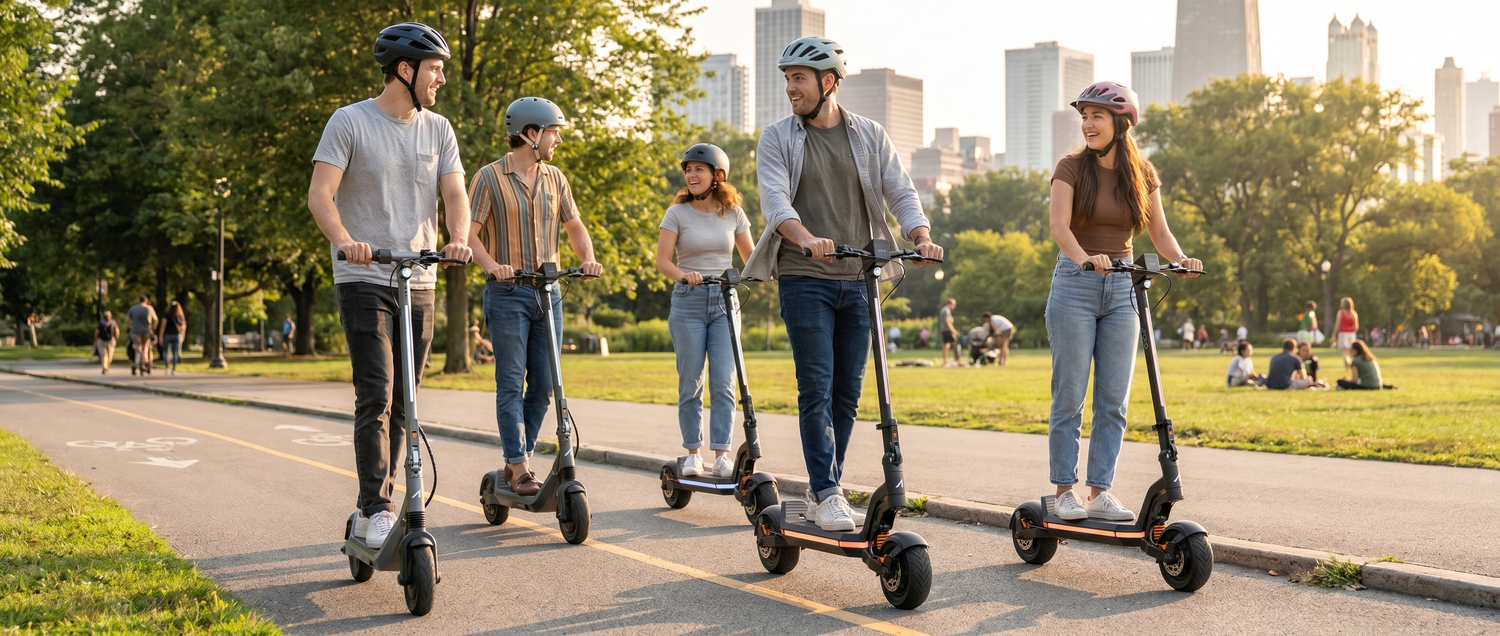
For most riding (on average between 15 to 25 mph) on a flat, paved path, separating scooters from bicycles doesn't solve many of the problems. The speeds largely overlap with what confident cyclists already ride, and splitting infrastructure by vehicle type (rather than by speed or by pedestrian proximity) adds cost and complexity without a clear safety return.
Sidewalks are a different story entirely, for scooters and bikes alike. Wherever a real bike lane or path exists, both should generally use it instead of the sidewalk, for pedestrian safety. Where no separated infrastructure exists at all, that's a genuine gap; not a scooter problem, but an infrastructure one.
What actually helps: banning, better rules, or better infrastructure?
Why outright bans tend to backfire
Banning e-scooters, or banning them from shared lanes specifically, is the blunt-force option, and it doesn’t solve anything but rather iit tends to create new problems while only partially solving the old ones. Riders don't stop riding; unregulated, unregistered scooters proliferate instead, ridden by people with even less incentive to follow safety rules. Cities also lose the traffic, parking, and emissions benefits that come with scooter adoption. And pushing scooters onto roadways instead of bike lanes increases the danger of car-versus-scooter collisions while slowing vehicle traffic further.
What tends to work better
-
Regulate behavior, not just hardware. Much of today's scooter legislation was written for early 2010s rental fleets (ie. novice tourists, with minimal training and occasional intoxication). Usage has diversified since; rules should evolve alongside it, especially for adult, experienced riders who don't need the same hardware limits as first-time or underage riders.
-
Invest in rider education. Drivers are tested on rules and safe operation before they're licensed. Scooter riders generally aren't and a lightweight version of that (rules of the road, safe following distance, when to slow down) could meaningfully cut down on reckless riding.
-
Scale infrastructure to match real demand. Municipalities that study current path usage — not usage from five or ten years ago — can plan lane width, protected crossings, and parking/charging areas that actually match today's volume.
Frequently Asked Questions
Are e-scooter injuries actually rising?
Reported injuries are rising, but so is ridership. UCSF-affiliated research found e-scooter injuries climbing about 45% year-over-year from 2017–2022, but that figure isn't adjusted for the much larger number of riders, trips, and miles logged over the same period.
Should e-scooters share bike lanes with bicycles?
In most cases, yes, for the same roads and paths cyclists already use, since a 15–20 mph scooter travels at roughly cycling speed. The real issue is rising path congestion and inexperienced riders operating at their scooter's physical limit, not scooters versus bikes as a category.
What is the speed and power limit for e-scooters in Australia?
Australia doesn't have one either — and the number people misapply here usually comes from the e-bike standard, not scooters. The national e-bike benchmark is 250W continuous with a 25 km/h cutoff (200W for throttle-only bikes), based on the European EN 15194 standard, reinstated as the required standard for e-bike imports. Scooter limits are set state-by-state and are all over the map: Victoria historically capped e-scooters at 200W and 10 km/h before full legalisation, while post-legalisation Victoria now allows e-scooters up to 25 km/h top speed, ridden no faster than 20 km/h in practice, weighing no more than 45 kg. Meanwhile NSW currently caps trial-site scooters at 20 km/h on roads and 10 km/h on shared paths.
Where are private e-scooters banned in Australia?
In NSW and the Northern Territory, privately owned electric scooters aren't permitted in public places at all — NSW residents can currently only ride a shared/rental e-scooter, and only inside designated trial sites (as of mid-2026 that's limited to Forster-Tuncurry and Wollongong, though NSW has floated an "e-micromobility Action Plan" to legalise shared-path scooter riding at 10–20 km/h). Private ownership is legal in Victoria, Queensland, WA, Tasmania and the ACT, each with its own speed/weight/age rules — Victoria, for example, requires riders to be at least 16, wear a helmet, stay off footpaths, and cap speed at 20 km/h
Should cities ban e-scooters instead of expanding lane capacity?
Bans tend to backfire, pushing riders onto sidewalks or unregulated scooters, erasing traffic and emissions benefits, and increasing car-versus-scooter collisions if scooters shift to roadways. Rider education, smarter enforcement, and scaled-up infrastructure tend to outperform outright bans.
Regulations referenced in this article reflect research current as of July 2026 and are provided for general information only, not legal advice. Always confirm current rules with your local government before riding.